
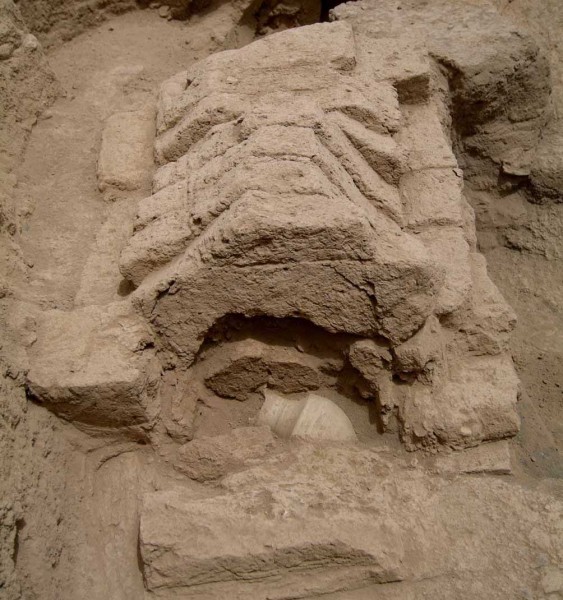
GP02
Type of burial and vault. Chamber grave, “diamond” vault.
State of preservation. The grave was well preserved and intact and has been fully excavated. The pit was rectangular, with dimensions about 1.5 x 1.05 m, oriented on the E-W axis.
Burial descriptions. The grave chamber was oriented on the E-W axis. The outer dimensions were 1.1 x 0.8 m, and the inner dimensions were 0.75 x 0.4 m. The ceiling was formed of seven bricks laid in a diamond pattern. The northern and southern walls were built of four layers of half-bricks laid horizontally. The entrance to the chamber was closed by two whole bricks laid horizontally and two bricks laid vertically on them. The dimensions of the bricks used in the construction were 38 x 38 x 9 cm and 38 x 19 x 9 cm.
Human remains. A 3-year-old child was buried in the grave. The bones were preserved in bad condition but in anatomical order. The body was lying in a contracted position, on its right side, the head to the east and the back to the southern wall of the chamber. The hands were bent, and the palms were near the face.
Animal remains. Some animal bones (ribs, vertebra, tibia, talus bone) belonging to sheep/goat were found in the NE corner of the chamber
Evidence of burial rituals. A meat offering had been deposited in the grave chamber.
Burial goods. Two vessels were found inside the grave, both decorated with painted horizontal bands. The bigger one was laid on the side behind the child’s feet and the smaller one near its left hand. The child had two bronze bracelets on its wrists. Besides, three beads (one made of rock crystal and two of cornelian) and a shell roundel lay by its neck
Description Joanna Mardas/archaeologist/Inventory Xenia Kolińska/archaeologist
| BIOARCHAEOLOGIST ANALYSIS |
Human remains
A fairly complete and relatively well-preserved skeleton of a 3-year-old child. Bones were slightly weathered, with spots of crystalline deposits. Very clear linear enamel hypoplasia has been observed at all developing crowns of anterior permanent teeth. Initial cribra orbitaliawas present in the left orbita.
Dr. Arkadiusz Sołtysiak/IA UW/anthropologist
Animal remains
GP02 chamber grave with "diamond" arrangement of the vault contained 51 bone fragments, most likely belonging to one individual of the sheep. They were found in a cluster in the northeastern corner of the grave chamber, near the head of a three-year-old child of unknown sex. The vast majority of remains (49 pieces) represented valuable elements of the trunk from the point of view of consumption, among which fragments of ribs, including the cartilagineous ones, sternum and vertebrae from thoracic, lumbar and caudal segments were distinguished. In addition, the right tibia and talus bone were determined. The fresh concretion of the distal tibial epiphysis with its diaphysis indicates that the individual was approximately 20-22 months old. Based on the lateral length of the talus, the height at the withers was calculated to be 63.5 cm. This means that the sheep represented a small form, similar to a mouflon.
Dr. Joanna Piątkowska-Małecka/IA UW/archaeozoologist
Malakology
| Inventory number |
Function |
Species |
|
|
37-60-104-5 |
roundel/ring of shell |
unidentified |
marine |
Dr. Aldona Kurzawska/IAE PAS/malakologist
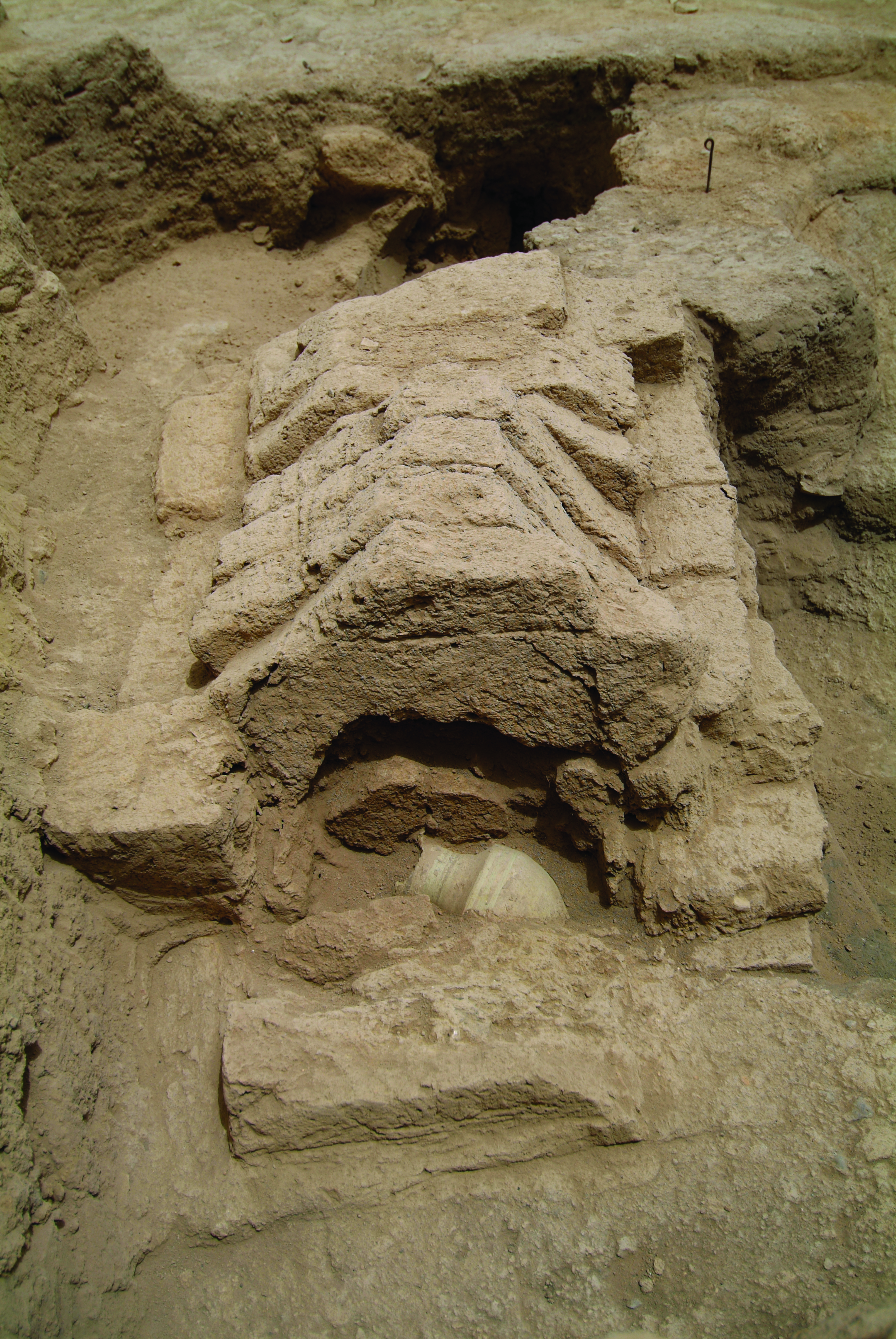
GP02 before exploration. Entrance.
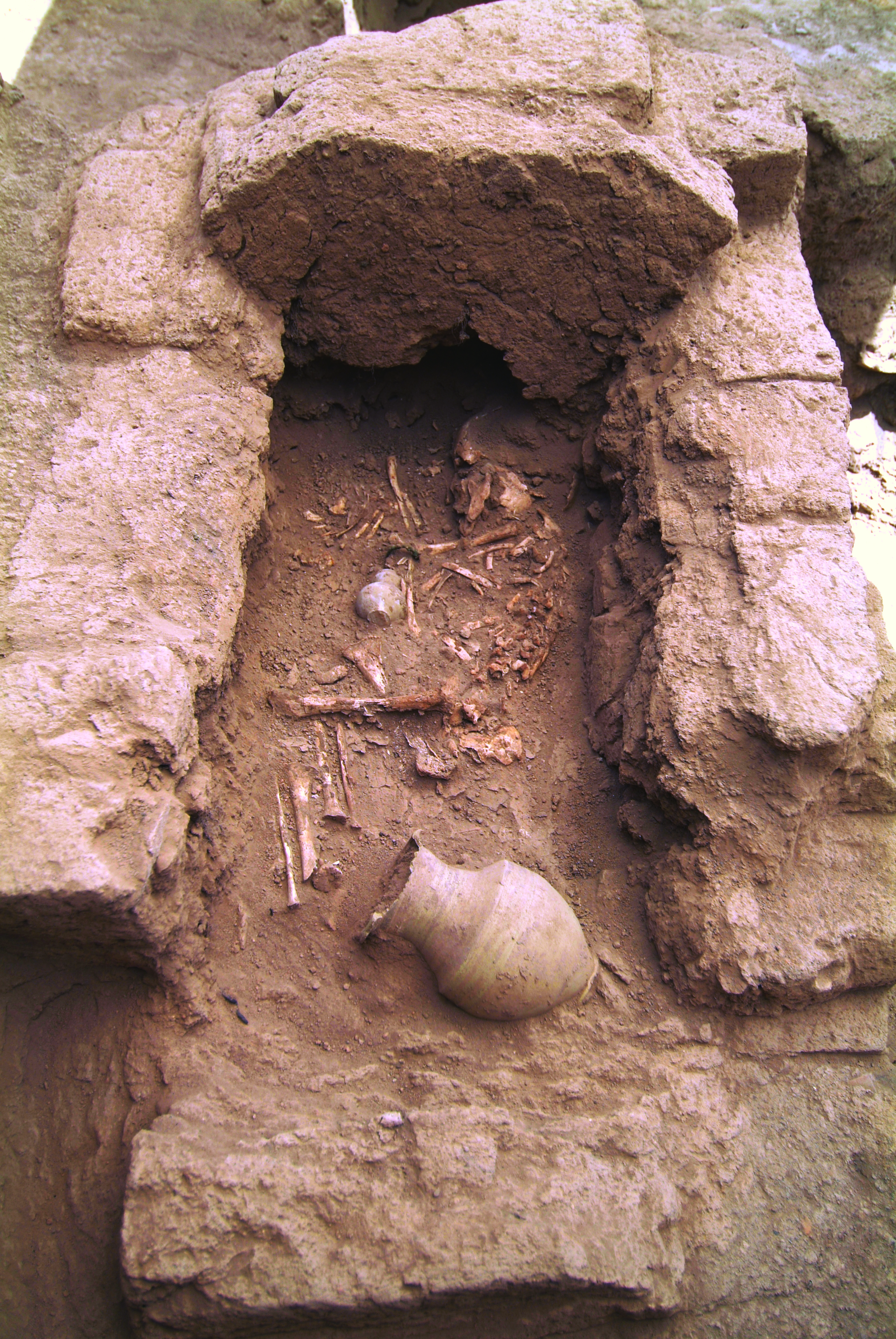
GP02 during exploration.

GP02 before exploration.

GP02 during exploration.